Wednesday, December 9, 2015

What's the Significance of the Triad Claw?

If you look at enough historical paintings or portraits, eventually you'll notice that many of the subjects are flashing a gang-sign: the triad claw, which is either an "M" shape or a "VVV", depending on how you look at it.

Alfonso V of Aragon (1557) by Vicente Juan Masip

You'll find this hand signal in portraits of political figures, artists, religious figures, entertainers over a span of centuries, including today.


Cardinal Ratzinger
So what is it?

Some speculate it's a Masonic hand gesture, which seems to be correct, but the portraits from the 16th century predate masonry. Some speculate it's a signal of "crypto-jews", i.e. people of jewish ancestry who converted to catholicism, but retained their ethnic and religious identity in secret. Another possibility, especially in the older portraits is that it's a symbol of initiation in Rosicrucianism. All of these explanations are essentially the same. That is, this hand sign is a sign of initiation in an underground religious or spiritual society.

The alternative media and conspiracy media seems to be imbued with a strain of medieval thinking, or latent christianity. There's a tendency to regard any other spiritual or religious viewpoint as "satanic" or evil, certainly opposed to the well being of ordinary people. Most of the web sites that delve into this topic follow that line of reasoning.

The esoteric tradition, the perennial religion, is ancient, probably as old as humanity itself. However, forced conversion of people to  Christianity or Islam and attempting to stomp out all competing forms of knowledge and belief is a relatively new thing, hopefully an aberration in human history. From my perspective, the western world's still recovering from the attempt to steamroll any competing religious and spiritual point-of-view.

Anyway, I'll continue searching for the oldest recorded use of this hand sign and see if that sheds any light on its significance. (See more recents posts on this including 13th century paintings, Renaissance Paintings, and Glorious Revolution Paintings.)

Monday, December 7, 2015

The Nika Riots: Vertical Integration of Society


The Nika Riots serve as a microcosm of every society. In Constantinople at the time (532 AD), people were organized into demes which were divisions of society that were organized around chariot racing teams. The teams had colors: Reds, Greens, Blues, and Whites which the supporters would wear to demonstrate their loyalty and membership. The demes were also supported by aristocratic patrons, which seems to be a common mode of organization (cf Roman Patronage)in the ancient world (and even today).

It's not very hard to imagine that the ancient priesthoods could be integrated into this type of societal structure, where one or more of the pantheon of gods would be the chief deity of the deme. In the Christian era of Byzantium, some subset of the Christian branded pantheon of gods could serve the same purpose.

The beliefs, and the mythological stories that seem to express those beliefs serve as a sort of glue to bind these factions together.


Myths and Politics

In recent years, a medieval theme has re-emerged as a trope for daily discussion, or at least tweeting and facebook posts: "the clash of civilizations". In this case the clash is between the West, which many people conflate with Christianity, and Islam.

These memes tend to only make sense when viewed through a very, very soft focus lens. Boiling down centuries of history, the actions of billions of people and countless religious sects to a single slogan, sentence or a paragraph, of course, would.

The clash of civilizations trope shows one way mythology works, or shows its function in political life. The people who believe a thing called "christendom" exists seem to mean they want to belong to the christendom team. As discussed in earlier posts, people in the western world have lived in a succession of empires, and are essentially de-tribed, but we retain an instinct to belong to a tribe, which we've generalized to the concept of a team.

Ironically, people believe "christendom" is under attack because of the fervent beliefs of the "islamic" terrorists. The language of the terrorists, e.g. infidels, serves to define sides of a conflict.

Symbols and stories can help to define political boundaries. Symbols and vague beliefs are almost always more real than reality. While "christendom", which bristles with the most advanced weaponry in human history, is under threat by impoverished young dudes with AK-47's who are financed by the supposed allies of the West, or by the West itself, political boundaries can be defined by very vague beliefs and symbols.

Retelling of legendary historical stories, e.g. The Song of Roland, in this context can suddenly make them seem extremely significant. Maybe this is one of the ways that religions make use of mythology. Popular stories or fables, or even the oddball stories of astro-mythology, make the transition from entertainment to hallowed artifacts. They become a thing, an institutional property.

Saturday, December 5, 2015

Flow of Information

An earlier post cites a scholarly article by A.L. Frothingham on the history of the caduceus. Frothingham speculates that Hermes possibly originated as a god of fertilization. He's the spirit of the union between the earth and the sun which makes the germination of crops possible. From this kernel, the god's role expands to include every aspect of intercession: boundaries, commerce, pleading on behalf of men to the gods, delivering messages to men from the gods, and so on.

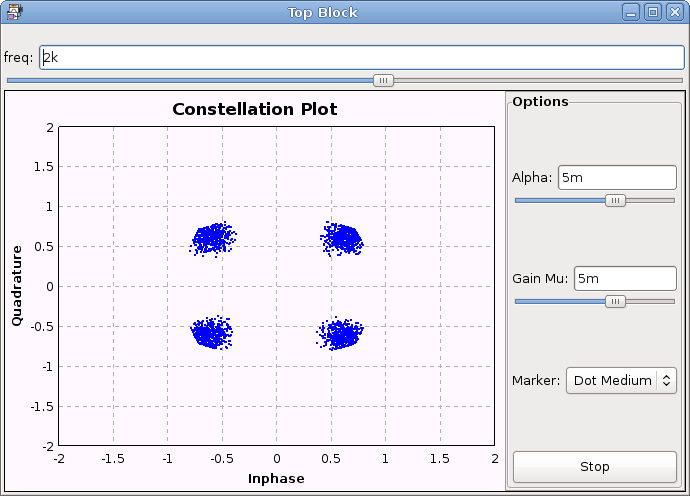
GNU Radio QPSK Constellation Plot
Hermes is an instance of what I sometimes think of as "the third thing", that which arises from two or more things. Information is maybe the best example of a third thing. In RF telecommunications, for example, information is conveyed by symbols that are encoded, transmitted and decoded by modems.

Information is present in natural situations, too. A shadow cast by a tree creates a region of light and dark. The rotation of the earth creates night and day. The orbit of the moon causes it to appear to go through phases of illumination. A drop of honey in a glass of water causes a gradient of sugar concentration, and so on.

If men can build a modem that sends and receives binary information in constrained, contrived conditions, maybe it's possible to build a device that taps into the flow of information of nature.

Friday, December 4, 2015

The Betrayals of Jon Snow, Jesus, and Osiris

If you go out on a clear night around this time of the year (December) and look up, you'll see Orion dominating the night sky. The constellation seems to be the main character in many myths and legends. In my previous post, I discussed how the dismemberment and roasting of Anakin Skywalker in Star Wars is probably an artistic depiction of the helical rising of Orion.

Star Wars seems to be based primarily on the stories of Osiris, Seth, Isis, and Horus. The scenes, characters, and even terminology of the saga can be mapped to a counterpart in stories drawn from Egyptian mythology. The Game of Thrones seems to be based on a fusion of Egyptian, Christian, and Greek mythology, rather than a single source.

In GoT, the Orion character is Jon Snow. Orion or Osiris is the lord of the winter sky and the king of the dead. Through the 5th season, Jon Snow's wardrobe becomes a visual allusion to the constellation. He wears all black, has a fur cape, carries a long sword and has a studded belt.

If Jon Snow is Orion in GoT, and Anakin Skywalker was Orion in Star Wars, then Jon's father, Eddard Stark serves as the Aquarius/Jon the Baptist/Obi Wan character who loses his head as the wheel of the story spins.

Onorio Marinari, Salome with the Head of Saint John the Baptist, c. 1680

Sansa Forced to Look at Ned's Head
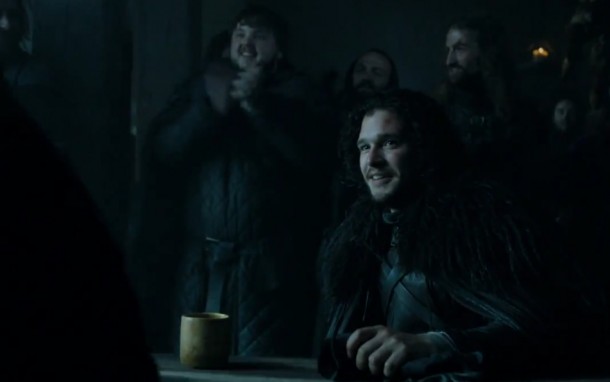
In GoT season 5, Jon Snow follows a Jesus-y trajectory. He is elected "Lord Commander" of the Night's Watch in a way that parallels Jesus's triumphant procession into Jerusalem to be King of the Jews. Jesus, the carpenter, is carried by a donkey, just as Hephaestus (the god of blacksmiths and craftsmen) is carried back to Olympus on the back of a donkey. Jon Snow is carried into office on the figurative back of his comic-relief Sam (cf  Samwise Gamgee).

Lord Commander Jon Snow (Orion)
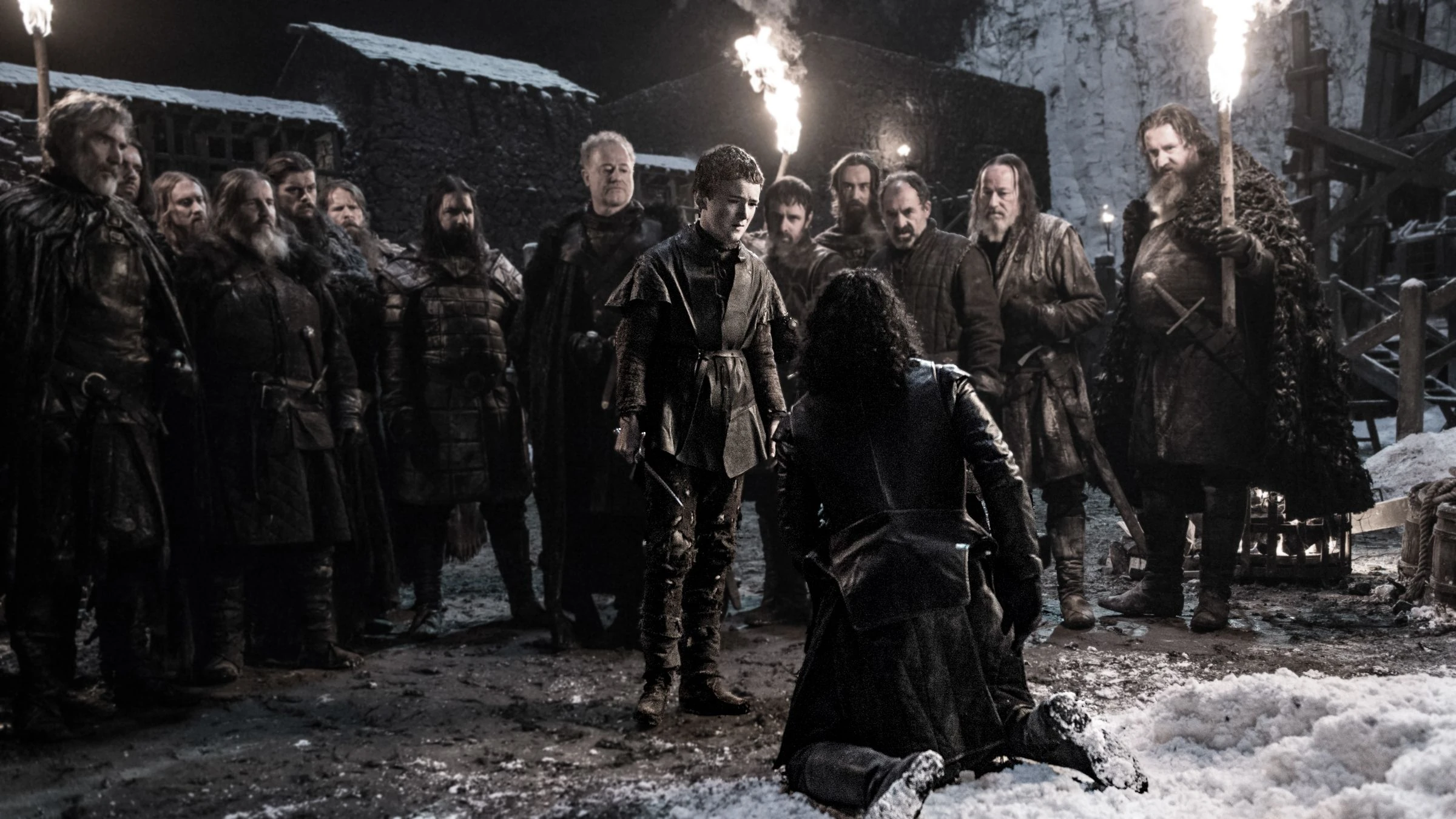
As with Jesus, Osiris, Orion, or even Baldr (of Norse Mythology) the triumph is short lived. There's a horrible betrayal, and the mighty one is destroyed. In the case of Jon Snow, his confidant and aide Olly plays the role of Judas and tricks Jon into becoming the target of a gang of murderers who stab him over and over in the stomach.
Jon Snow betrayed and Stabbed Repeatedly
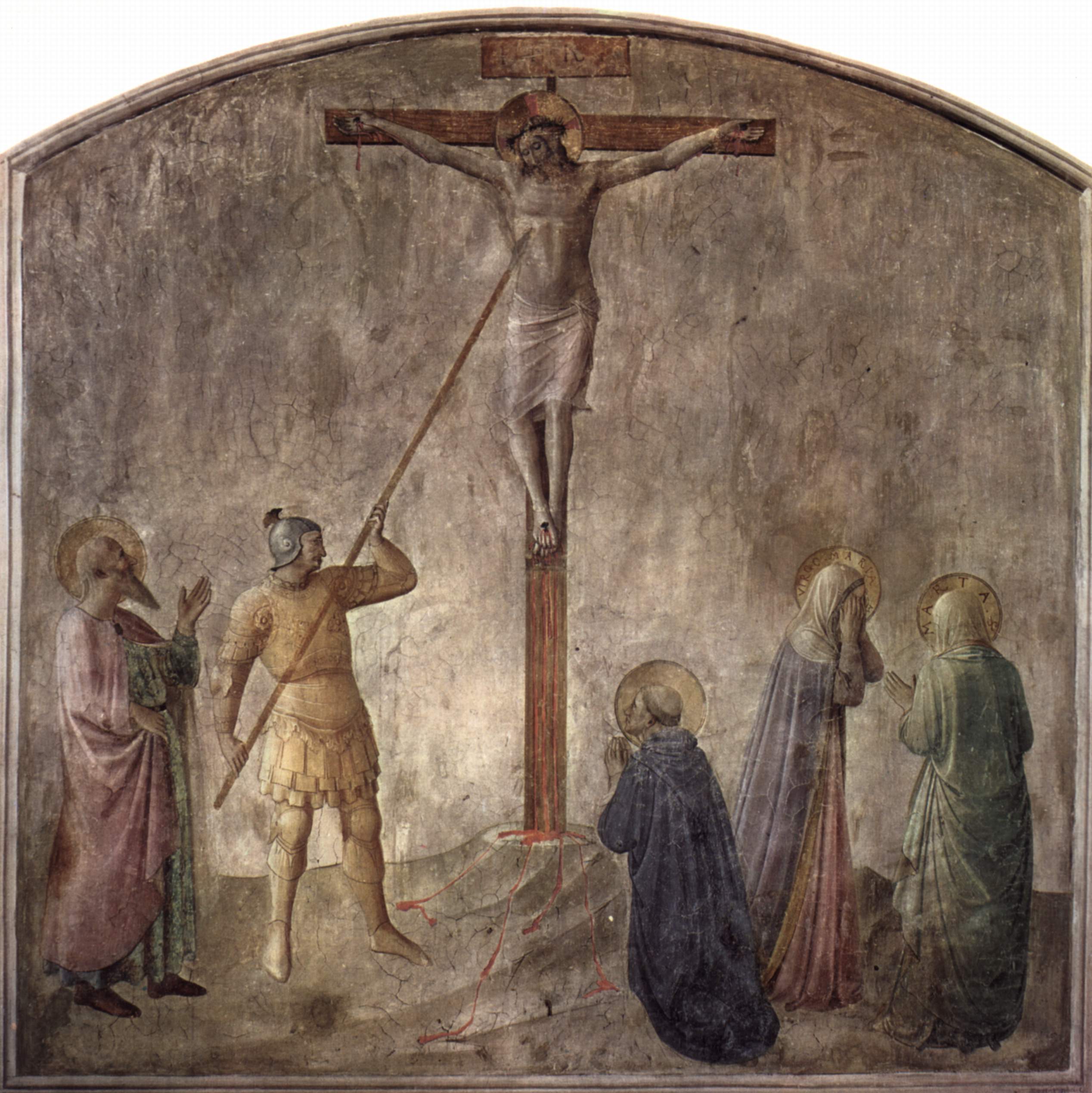
Cross shown Briefly on Camera to Underline
Jesus-y Scenario
When the constellation Orion character is betrayed or tricked into his fatal situation, or someone else is tricked into "killing him" as happens over and over again in myths, his studded belt becomes a wound. The murder weapon can be an arrow, a spear, a dagger, a sword, a scorpion sting, or even a sprig of mistletoe (for Baldr).

The next phase of the myth is for Jon Snow to begin his journey into the underworld as King of the Dead. So where Mustafara serves as the visual metaphor for the entrance of the Duat in Star Wars, The Wall in the Game of Thrones serves as the entrance, that is, the horizon.

Wednesday, December 2, 2015

The Roasting of Anakin Skywalker

WARNING: I think I'm on the right track with this post and the astro-mythology, but the details are time consuming to pin down and some of the finer points might be mangled.

In ancient Egypt, the Helical Rising of Sirius marked the start of their year. It heralded the flooding of the Nile and a new agricultural cycle. Sirius was the star of Isis, and heralded the return of the constellation Orion (Osiris) to the sky. In the Star Wars saga, Anakin Skywalker's "death" and resurrection as Darth Vader and subsequent re-birth as Luke's father parallels the Osiris cycle.

Anakin's defeat by Obi Wan is the dramatization of the roasting of Orion by the Sun in the summer. The following GIF was created using Stellarium. It shows Aquarius in the night sky (Obi Wan) preceding the rising of Orion, then "roasting" by the dawn light.

In Star Wars the young Obi Wan (who probably maps to John the Baptist/Aquarius) fights Anakin in a hellish landscape. The hellish landscape represents the entrance to the mythological Egyptian underworld called the duat. It was the world at or over the horizon, hence in Star Wars it is depicted as a fiery place. (cf the Lion King) Interestingly, the battle between Obi Wan and Anakin takes place in Mustafar and the Lion King's name is Mufasa which are apparently bastardizations of the name Mustafa which mean "the chosen one" in Arabic. (cf Neo in The Matrix)


Aquarius/Obi Wan beseeches Anakin to give up because he has the "higher ground". (See the GIF above which shows Aquarius in the higher position overnight.)


Aquarius/Obi Wan defeats Anakin by cutting his legs off and leaving him to cook. The cooking and fire represent the sun. Anakin is torn to pieces the same way the stars of Orion fade bit by bit in the morning light.


Once he's recovered by the Emperor, Anakin subsequently becomes entombed in a perfectly fitting sarcophagus and rules as Lord of the Dead. The Empire in the movies is possibly the duat. It's an entirely material fake place, even the people are manufactured. (cf The Lord of the Rings, or Bladerunner)

Meanwhile, Obi Wan Kenobi goes on to help the Rebel Alliance before he re-encounters Darth Vader who chops his head off. There are parallels with the Game of Thrones between Obi Wan/Vader and Eddard Stark/Jon Snow. I'll get into those in a future post.

Hollywood Dramatization of Supernatural Phenomenon

Over the past few years, I've come to believe what we think of as supernatural is actually commonplace and we tap into it all the time. The processes of art, of creation, of problem solving involve a plunge into the well of imagination and allow us to see beyond the confines of the senses and contemplate what's not there. For me, that is also how we get in touch with the gods.

The show-biz depiction of the supernatural is extremely visual, by necessity. Gods take human forms and wear the tunics or robes of classical antiquity. In their comic-book forms they fly, shoot laser beams out of their eyes, or tear objects apart with their bare hands.

The show-biz depiction is an updated form of the statues and sculptures of classical antiquity. Those were larger-than-life perfect human forms in bronze or marble, sometimes decorated with gold, jewels and multi-colored paints. They were sometimes enhanced with primitive special effects trickery, which enabled them to speak or move like theme-park robots.

The bombastic representation of the gods crowds out the more subtle, omnipresent experience we have. If our imagination is a wilderness, then the commercial or official representation is like paved roads or litter in the primordial paradise we carry around with us.