Showing posts with label Star Wars. Show all posts

Friday, January 8, 2016

George Lucas's White Slavers Comment

George Lucas publicly compared Disney to "White Slavers", then withdrew the comment.

White Slavery, of course, refers to the practice of abducting white women and children generally to use as sex slaves. That phrase is a pretty interesting choice for a description of Hollywood or the Disney conglomerate by someone who is, presumably, pretty knowledgeable about its inner workings.

The conspiracy minded might immediately leap to the conclusion that Disney actually traffics in women and children, however, I'm thinking Lucas was actually using the term in a figurative sense and is bitter about selling the rights to Star Wars for funny money.

Wednesday, December 16, 2015

Star Wars Wheel of the Year

Wheel of the Year Using Star Wars Characters
Star Wars is a really good example of a series of movies that incorporates imagery and characters that are drawn from mythology, and hence nature. The "Wheel of the Year" above is a stab at showing some of the visual vocabulary in the series and how it (probably?) relates to the solar cycle.

Episode IV: A New Hope (the first Star Wars movie) kicks off with Luke leaving home and ends with the destruction of the first Death Star in a scene that's reminiscent of the illumination of the inner chamber of New Grange on the Winter Solstice. Luke (the sun) blows up the Death Star by shooting a load down its shaft, so to speak. The destruction of the first Death Star, I think, corresponds to the Winter Solstice. It's only a small triumph of light over dark because Darth Vader escapes.

Many people's favorite Star Wars movie is The Empire Strikes Back. In that film, Luke and Han are betrayed by Lando Calrissian. Where the anti-Luke (the Winter Sun) is Darth Vader, the anti-Han is Lando (the winter moon?).

The Anti-Han
Lando's betrayal leads to a duel between Darth Vader and an untrained, inexperienced Luke. Darth kicks his ass. He asks Luke to "Join the Dark Side", i.e. the winter, and lets him know he's his father. (The Osiris to his Horus.) Luke of course will never join the dark side. Consequenly, he plunges from the "cloud city", just like the Sun falls from the sky through the autumn. He ends up looking all dingy and beat-up, and hangs from a cross to be rescued by Leia and Lando. This, I think corresponds to the autumn equinox.

Finally Luke goes to Dagoba: a water/earth vegetation planet where his X-Wing fighter crashes in the swamp. Luke emerges from the water and begins his ascent in skill and power. By the finale of the movie, he duels Darth Vader on more equal terms. He is garbed in black as he emerges from the winter side of his cycle, and his light saber is vegetation-Osiris-green. Luke shoots up from the bottom of a pit in this duel, while in the Empire Strikes back duel, he plunges into one.

Luke and Darth fight to a draw, but the Emperor (Seth) starts zapping Luke until Darth Vader chucks the Emperor down another chute into the core of the Death Star just before it is destroyed. In the struggle Vader is mortally wounded. Finally, Anakin emerges from his sarcophagus suit to look upon his son with his own eyes, then dies. This corresponds to the spring equinox.

Finally, the second death star is destroyed and the rebels win and everyone in the empire is free. This probably corresponds to the summer solstice, or maybe to the ascent of the sun into the sky in the spring (on his way to the solstice).

Friday, December 4, 2015

The Betrayals of Jon Snow, Jesus, and Osiris

If you go out on a clear night around this time of the year (December) and look up, you'll see Orion dominating the night sky. The constellation seems to be the main character in many myths and legends. In my previous post, I discussed how the dismemberment and roasting of Anakin Skywalker in Star Wars is probably an artistic depiction of the helical rising of Orion.

Star Wars seems to be based primarily on the stories of Osiris, Seth, Isis, and Horus. The scenes, characters, and even terminology of the saga can be mapped to a counterpart in stories drawn from Egyptian mythology. The Game of Thrones seems to be based on a fusion of Egyptian, Christian, and Greek mythology, rather than a single source.

In GoT, the Orion character is Jon Snow. Orion or Osiris is the lord of the winter sky and the king of the dead. Through the 5th season, Jon Snow's wardrobe becomes a visual allusion to the constellation. He wears all black, has a fur cape, carries a long sword and has a studded belt.

If Jon Snow is Orion in GoT, and Anakin Skywalker was Orion in Star Wars, then Jon's father, Eddard Stark serves as the Aquarius/Jon the Baptist/Obi Wan character who loses his head as the wheel of the story spins.

Onorio Marinari, Salome with the Head of Saint John the Baptist, c. 1680

Sansa Forced to Look at Ned's Head
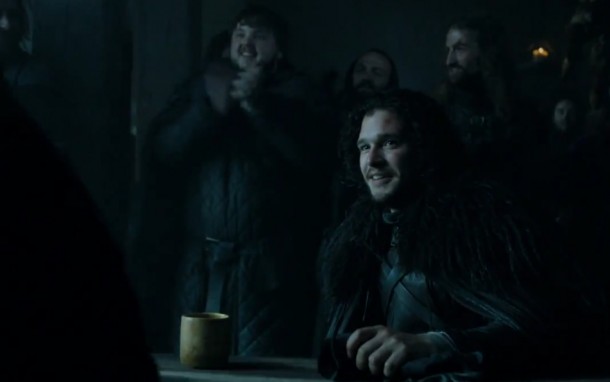
In GoT season 5, Jon Snow follows a Jesus-y trajectory. He is elected "Lord Commander" of the Night's Watch in a way that parallels Jesus's triumphant procession into Jerusalem to be King of the Jews. Jesus, the carpenter, is carried by a donkey, just as Hephaestus (the god of blacksmiths and craftsmen) is carried back to Olympus on the back of a donkey. Jon Snow is carried into office on the figurative back of his comic-relief Sam (cf  Samwise Gamgee).

Lord Commander Jon Snow (Orion)
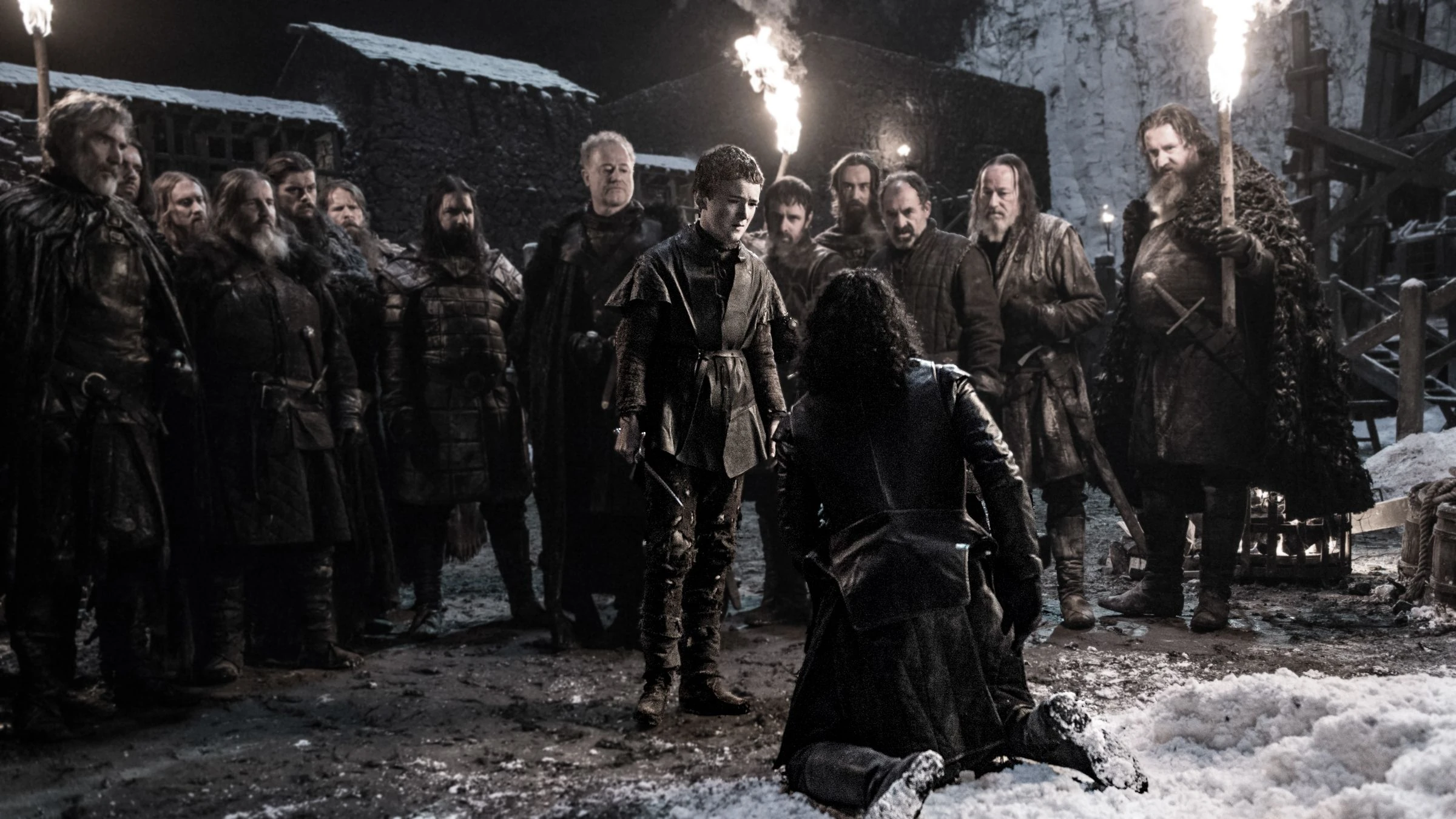
As with Jesus, Osiris, Orion, or even Baldr (of Norse Mythology) the triumph is short lived. There's a horrible betrayal, and the mighty one is destroyed. In the case of Jon Snow, his confidant and aide Olly plays the role of Judas and tricks Jon into becoming the target of a gang of murderers who stab him over and over in the stomach.
Jon Snow betrayed and Stabbed Repeatedly
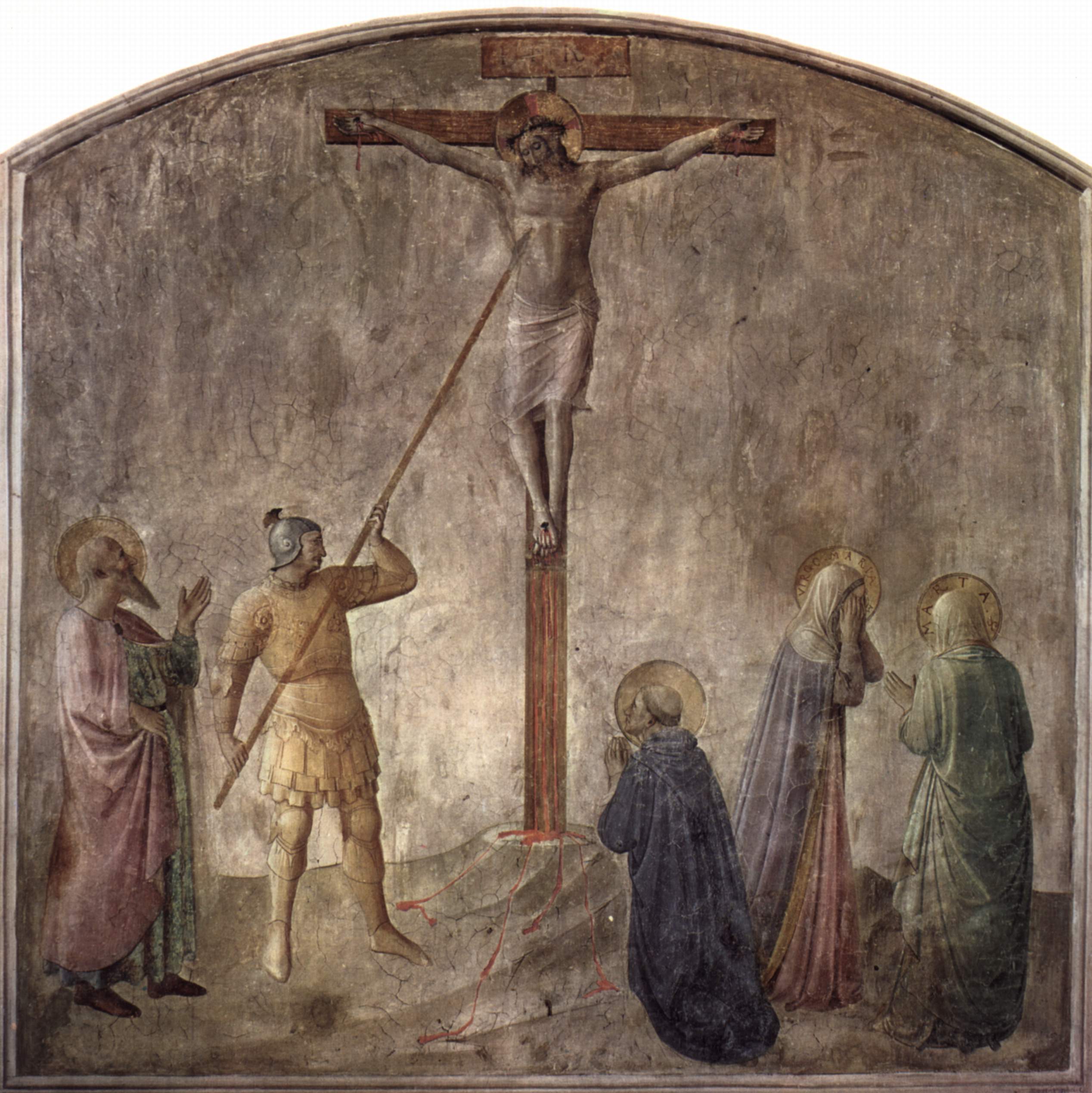
Cross shown Briefly on Camera to Underline
Jesus-y Scenario
When the constellation Orion character is betrayed or tricked into his fatal situation, or someone else is tricked into "killing him" as happens over and over again in myths, his studded belt becomes a wound. The murder weapon can be an arrow, a spear, a dagger, a sword, a scorpion sting, or even a sprig of mistletoe (for Baldr).

The next phase of the myth is for Jon Snow to begin his journey into the underworld as King of the Dead. So where Mustafara serves as the visual metaphor for the entrance of the Duat in Star Wars, The Wall in the Game of Thrones serves as the entrance, that is, the horizon.

Sunday, November 15, 2015

Why is Star Wars Interesting?

Money from They Live
In the remote past, my ancestors lived a life that was governed only by the cycles of nature, by the rising and setting sun, by the seasons, and by rain and drought. They were of nature, and in nature. Their gods and mythology was right there. What was within them was also all around them.

Today, the people of the West are far removed from our origins. As discussed in an earlier post, we're cut off from nature, and our ancestors have lived in a succession of cities, states, and Empires. Historically, Empires have stripped people of their religious identity by dissolving old systems of belief, and imposing new ones. Also, Empires strip people of their tribal identity. Beliefs and ties of loyalty to a tribe stand in the way of domination from a central location by a small group of people. After millenia of this process, the wild places of the western mind were settled and paved over, and controlled by imperialists. Shamanic religion and mythology were replaced with History and a strident insistence that mythical stories really happened.

Serapis
One prime example of this process is provided by the introduction of the god Serapis by the Ptolemies. The cult was fabricated to fuse the Greeks and Egyptians together and bind them to their rulers. Another example is the Christianization of pagan Europe by the Catholic Church, but perhaps the most recent, and therefore best documented example is the ethnic cleansing and forced conversions of Native Americans by the succession of Empires that dominated the New World from the 15th century on. The cultures of the Native Americans were probably analogous to western peoples' ancient cultures. They lived in tribes and had shamanic religions, and in many cases, they lived a pastoral way of life.

Their way of life conflicted with the English way of life, of land ownership and agriculture, money, and domination by remote rulers through bureaucratic systems. This type of conflict, on the surface of it, seems to be about land and resources but maybe on a deeper level it's about what you're going to do with those resources or maybe its about which gods have hold of your consciousness.

Star Wars relies on buried, paved over and nearly forgotten mythological themes for story telling. As a retelling of The Contendings of Horus and Set, one of countless such clones, it draws upon a very basic story that was well known in the ancient world. It is a story about the cycle of the sun, about the seasons and vegetation, and about birth, death, and rebirth, and the body and the soul. For the average person living in the West, these myths are unknown, and the natural cycles that inform them only exist on TV and beyond the concrete covered landscape they inhabit.

Terminally ill Star Wars Fan Daniel Fleetwood
By imbuing the movie with imagery drawn from mythology, consequently, imagery drawn from nature: solar imagery, lunar imagery, phallic forms, and rounded breast forms, Star Wars resonates with patterns that are stored inside us, patterns that make us. But for most people, those patterns are buried under layer after layer of debris. They are not conscious of why they like the movies so much. For many people the movies are a religion. Daniel Fleetwood, for example, was a huge Star Wars fan and was able to see the latest unreleased version of the movie before his recent death. His remains will be stored in a light sabre shaped urn.

The connection with the gods, with mythology can be a source of liberation, a source of delusion, or a tool of manipulation. A point I'll make over and over again is that by its very nature, this exploration is radically subjective and personal and loaded with paradoxes. (like a blog about what's radically personal)

The Constellation Lepus, a rascally rabbit

Saturday, November 14, 2015

Star Wars and the Osiris Cycle

The Star Wars movies were the bible of many people in Generation X. I saw Star Wars: A New Hope in 1977 when I was only 5 or 6 years old. It was the first distinct event I remember being excited about. There was some build-up to it among the kids in the neighborhood and somehow everyone knew presumably through advertising and media buzz that the movies were going to be not only entertaining, but important. I do not remember the experience of sitting in the theater and watching the movie, but I know I loved it.

I'm not a huge fanboy, but since then, I've watched the entire series many times. Before I knew about the mythology content, I watched the series for its nostalgic value, to relive my childhood. Once I started studying mythology more intensely, though, I realized the series is entirely imbued with it.

George Lucas gave an extensive interview (It used to be on YouTube, but removed) about how he relied on Joseph Campbell's ideas of the Monomyth to craft Star Wars. (The monomyth's a generalized version of cyclical solar hero myths.) More specifically, the series seems to rely on the Osiris Cycle and its derivatives to provide not only the main story arc, but to inform the entire movie, including the imagery. Star Wars is literally about conflict between heavenly bodies, the constellations, stars and planets of Earth's night sky, that is their anthropomorphic characters as imagined by our ancient ancestors countless years ago. It's a retelling of the Osiris cycle--mostly found in The Contendings of Horus and Set.

Even though I find the parallels between the movies and the mythology completely fascinating, I think elaborating the entire thing will get tedious quickly, even for ardent fans. Instead I'll focus on some fairly arbitrary highlights.

Sunman/Moonman

Luke and Han, Sun/Moonman
Luke Skywalker and Han Solo are, together, Horus the Egyptian sky god, whose eyes are the Sun and Moon. The Sunman/moonman buddy movie trope is pervasive. The sunman is usually the "smart one" with long hair (Luke). The moonman is often portrayed as a gruff, action oriented military man (Han, the smuggler). Gilgamesh and Enkidu are such a pairing. Peachey and Danny from The Man Who Would Be King are another. More recent versions are Bo and Luke Duke from the Dukes of Hazard, Daniel Jackson and Colonel O'Brien from Stargate, Starsky and Hutch, or Sam and Dean Winchester from Supernatural.

The imagery associated with Luke is Solar. He flies an X-Wing fighter, which evokes the solar cross. His flight suit is fiery orange and his flight goggles are yellow tinted.

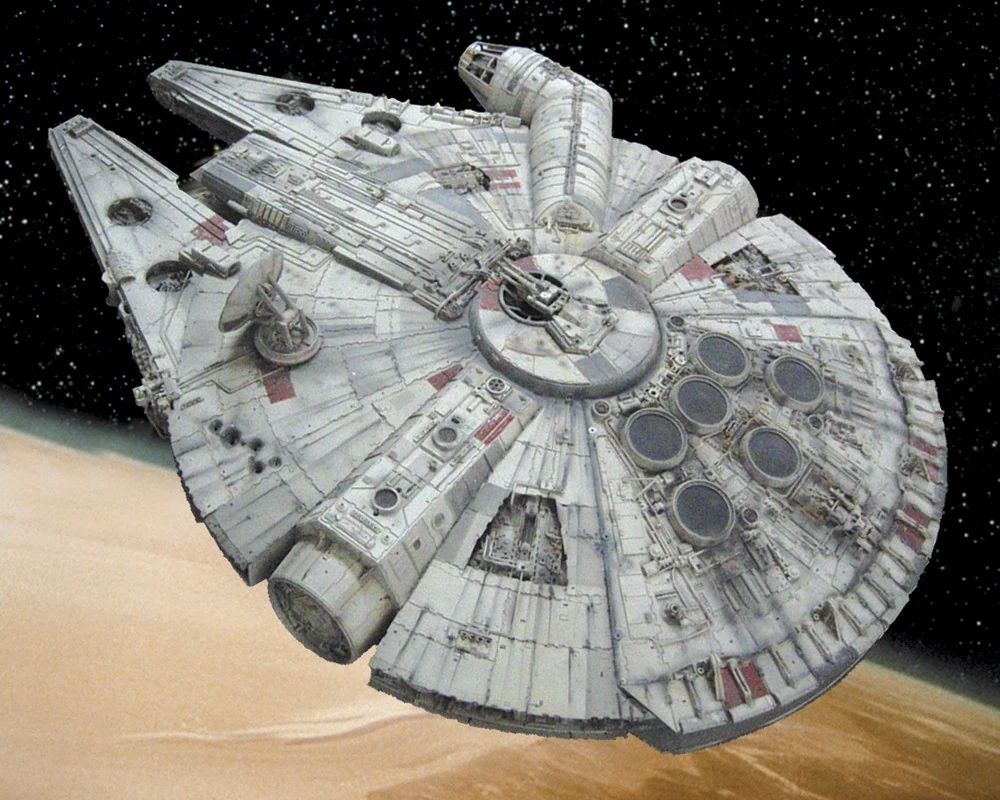
The imagery associated with Han is Lunar. He flies the Millennium Falcon (Falcon = Horus), which evokes the disk of the moon complete with cracks and craters. All the spaces in the Millenium Falcon are rounded to evoke the Moon.

The sunman/moonman pairing of Luke and Han is lampooned in the pairing of C3PO and R2D2. C3PO is golden, he's stiff and tall and "by the book", a protocol droid. R2D2 is short, stumpy and rounded and is fond of improvisation and is not afraid to go his own way.

Dick Pics

C3PO Collector Card
with Erection
An important element of the Osiris cycle is the creation of a Golden Phallus that Isis uses to replace Osiris' missing member and so get pregnant with baby Horus. In Star Wars C3PO seems to fill that role. C3PO is stiff and tall, in fact a collector card that appears to show C3PO with a big erection was "accidentally" released. In the series, C3PO gives aid to Padme to birth Leia and Luke.

The X-Wing fighter nose is obviously phallic, and the destruction the Death Star is destroyed by a sperm like photon-torpedo.

Underwater and Buried

Many fans think The Empire Strikes Back is the best of the Star Wars movies. Scenes in the movie are drawn directly from the Contendings. In The Empire Strikes back, Luke loses a hand to Darth Vader, just as Horus loses both hands to Set. When Luke is recovering, he's suspended in a watery tube, which parallels Horus and Set's contest to see who can remain underwater the longest.

Han Solo, instead of going under the water, ends up buried in "carbonite" with his hands sticking out, which is arguably one of the most iconic images of Star Wars, reproduced numerous times as coffee tables, ice cube trays, and wall hangings and Halloween costumes. (Maybe this represents the waning crescent moon?) And it parallels events in The Contendings when Set blinds Horus in the desert.

Princess Leia

In Star Wars, Leia is a Kick Ass Moon Girl, and she serves as a composite goddess character taking on the roles of both Isis and Hathor in The Contendings. She takes the Hathor role when she rescues Han in The Return of the Jedi.

Several of the key scenes with Princess Leia have direct parallels with scenes from The Contendings, but since this post is getting really wordy, I'll save that for another day.

In the next post, I'm going to riff on the Star Wars use of myths to explore how it works, that is, why are we so drawn to these stories.