Showing posts with label Vikings. Show all posts

Monday, February 1, 2016

The Vikings Aslaug Introductory Scene Decoded

For several months, I've been mulling over the scenes in the TV show Vikings where Ragnar's second wife Aslaug is introduced. Aslaug is met by two men who spy her emerging from the water. This obviously parallels the mythology of Aphrodite emerging from the foam in the Greek mythology.

From the "water" has a specific meaning in the parlance of celestial mythology. (See this post for more info.) The water, I believe, means the emergence of a constellation above the horizon, that is, the rising of the constellation before sunrise.

Additional clues are provided by Aslaug's accouterments when she meets Ragnar for the first time wearing a costume that answers his riddle. She wears a net, carries an apple, and has a dog companion.

The apple represents the sun, which, around the autumn equinox, rises in the hand of the constellation Virgo. The dog is the dog star Sirius, which heralds the arrival of Virgo in the morning darkness on the eastern horizon. Virgo is often frequently depicted in her various representations as being led by or riding a lion, that is, the constellation Leo. However, in this case, since the dog is on a lead, I think the allusion is to Sirius.

Stellarium Screenshot of Virgo Led by Sirius in October
The net is the Pleiades. and refers to the conjunction of Mars and Venus (the planetary doppelganger of Virgo characters) in the cluster of stars. (Nice write up: here)

Additionally, Aslaug is Ragnar's second wife, that is, his Autumn Equinox wife where Lagertha is his first, that is, his Spring Equinox wife, which of course means Ragnar is the Sun. This pairing of the two women follows an ancient celestial metaphor of Isis and Nephthys. In fact, when Ragnar meets Aslaug for the first time, there are numerous jokes about eating salted fish, which is probably a reference to the constellation Pisces.

Sunday, November 22, 2015

Vikings: The Gods and Actors

In a previous post, I noted that for many people in my generation Star Wars is like our bible and in fact its themes and characters are based on ancient stories that somehow seem to be coded in our DNA or maybe even in the physical fabric of our reality.

Vikings is similarly based on the legendary stories of Ragnar Lothbrok, which in turn, are based on mythological stories. Most of the characters in the story are the gods and the team of artists that produce the series rely on mythological imagery and allusions, and hence imagery and allusions drawn from nature, to dramatize the gods. Some of the characters seem to be based directly on one god in the Norse pantheon, while others, maybe even Ragnar, are syntheses of multiple gods. Indeed, syncretism seems to be one of the major themes of the series as Christianity bumps into the ancient religion of the people.

Floki Slithering through Tall Grass
The task of the actors in the series, then is channeling or evoking the gods. Vikings uses some subtle, and some not so subtle cues to accomplish this.

Ragnar takes on the roll of Odin. Throughout the series Travis Fimmel moves his head in an odd way and eyes the camera to evoke a bird, maybe alluding to Odin's ravens. He wears a raven insignia on his shoulder. He sometimes hops up on furniture in a scene or sits on a perch. Floki in the series is obviously Loki. He wears eye make up that evokes a snake's eye patches and moves in a serpent-like manner.

Aslaug
The female characters in the series, Lagertha and Aslaug evoke the ancient goddess character(s). (Check out David Mathisen's post on Isis and Nephthys for the dual nature of the goddess.)

As mentioned in an earlier post, Lagertha's a version of the kick-ass-moon-girl, although in her case, she's a full grown woman, the female version of Ragnar.

Aslaug's the pretty, icy, unfaithful, magic oriented red haired Venus type character. She first appears in water (like Aphrodite's birth), then shows up wearing a net (cf. Net of Hephaestus), and holding an apple (cf Judgement of Paris) and walking a dog. (I don't know the meaning of that one.) It's notable that the female characters don't seem to adopt the animal imitating style of the male characters.

Friday, November 13, 2015

Synedoche, Kennings and the Kick Ass Moon Girl

Katniss Everdeen; Kick Ass Moon Girl
Arguably, the most beloved character in  Western mythology is the Kick Ass Moon Girl. A close runner up is Kick Ass Moon Man, but we'll get to him in a future post. Since KAMG is well known to all, she serves as a good set of concepts to meditate upon.

The Katniss Everdeen character in the Hunger Games series is a recent well known edition of KAMG. Katniss has dark hair pulled away from her face, is a wild child, a virgin, at home with creatures of the forest, and opposed to the strange, corrupt, and perverse city dwellers.

Waxing Crescent Moon Among The Trees
KAMG is a set of concepts associated with the young crescent moon, shown at left (a great photo [I'm not the author]). There's no This=That equivalence in mythology. There's no dictionary. There's no canonical meanings, rather, there's a network of associations that are inside us. They exist inside the wilds of our imagination. By meditating on these characters we explore that landscape. Furthermore by meditating on these concepts, writing about them or making art about them, we change them and add to them.

Women are associated with the moon because the duration of the lunar cycle is approximately the same as the duration of the menstrual cycle. (One of the strong messages in the mythology is that cycles govern all.) Coincidentally, the duration of the orbit of Saturn is about 29.5 years, while the lunar cycle is about 29.5 days.

This pairing of women with the moon is a poetic association. It forms nodes in a web of information and mythology "facts" that only make sense within that web. It's like Synedoche, poetic kennings or even  Cockney Rhyming Slang. If the moon is a woman, then the young moon, the waxing Crescent is a young woman with dark hair pulled away from her white face, and maybe she's carrying a bow. If she's got a bow, then she's a hunter, or more generally kicks ass.

Scarlett Johansson as KAMG in Lucy
Like many other mythological characters male or female, KAMG's at home in the frontier. She abandons, or is plucked from her boring day to day life to kick ass and possibly to change the world. However, unlike male god or hero characters whose journey takes a more linear trajectory, change is an essential component of KAMG.

Two recent works play on this aspect of her. The movie Lucy uses the Persephone-Demeter story as the base theme for the plot. In the movie, Lucy goes through a mega cycle, and her character rapidly transforms again and again, and her consciousness and knowledge expand until matter and time yield to her mind and she reaches back to implant her wisdom in the hominid Lucy, the mother of all.

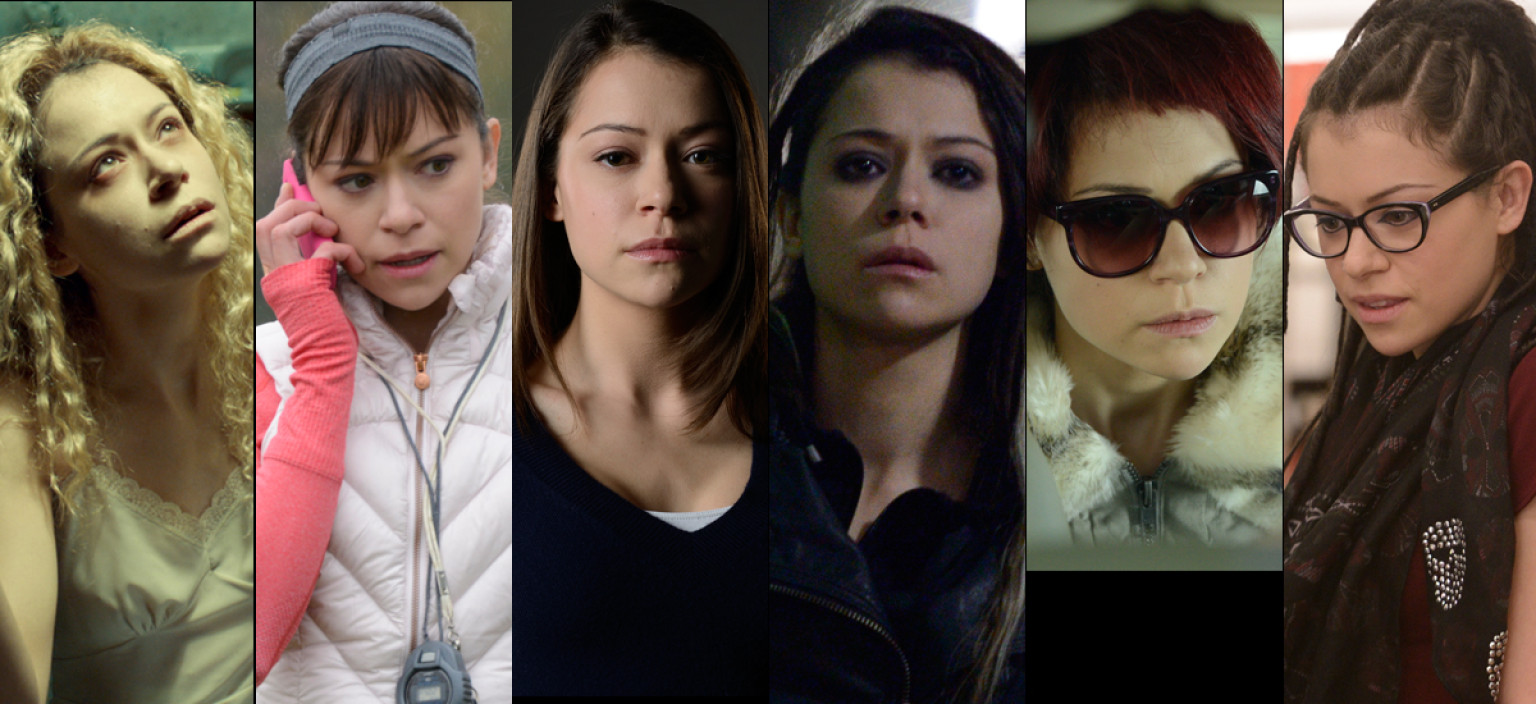
Tatiana Maslany portrays Clones in Orphan Black
A second, more comical take on this theme is Orphan Black where the main character is a series of clones all portrayed by the talented actress Tatiana Maslany.

One interpretation of the of the goddess characters in mythology is that they are all representations of some underlying polymorphous substance. In this aspect, they resemble the Earth from which plants grow, or the formless waters. There's some archaic, barely expressible concept nestled in this web of associations: perhaps at one time the world was undifferentiated for our most ancient ancestors (maybe pre-human, pre-mammalian even). All was one.
KAMG Lagertha and Cold Venus Aslaug from Vikings

However, there are distinctions among the goddess characters. KAMG, for example, is quite unlike the Venus character. KAMG is beloved, arguably the most beloved god in the pantheon. She's loved by all: men, women and children. The TV show Vikings even includes a joke about this aspect of her. Aslaug complains that everyone loves Lagertha while she's not accepted by the people.