Thursday, May 31, 2018

The Old King Analogy

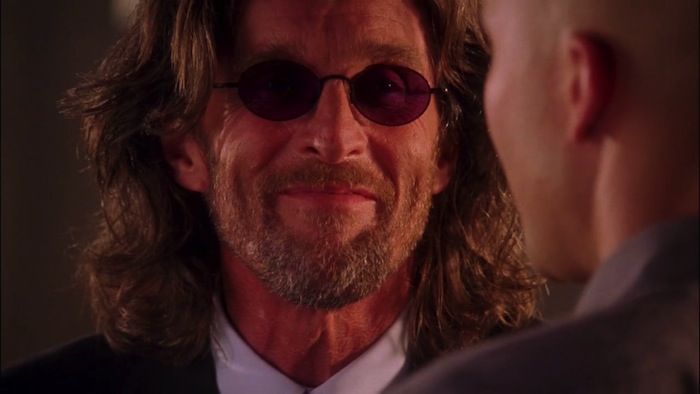
Lionel Luthor pretending to be blind.
One common archetypes in movies and TV shows is the Old King. There are many variations on this theme. I'll discuss one particular one in this post: the mad tyrant king.

A recent example is the father of Daenerys Targaryen from the Game of Thrones. The "mad king" in that case enjoyed burning people to death. "Lion"el Luthor in Smallville is another example. He's often the villain of episodes and in several episodes he's either completely demented or conniving.

I think the old king is last summer's sun. If you're sedentary cubical veal, then this analogy is puzzling. If you work outside in the summer especially on gardening or farm work, it's easy to comprehend. The summer sun can be a brutal task master. While the long days are good for getting things done, they're maybe too long. They can drive you beyond endurance, burn you, dry you out, and maybe in some cases, they can kill you.

I think the wealth that's attributed to this archetype is also easy to understand--all wealth is really a form of stored sunshine. The greek Plutus was an underworld god and scholars have speculated that he originated from the concept of seeds stored underground in clay pots.

The concept of "wealth" is a path to madness. It's like the old trying to hang onto youth, either through schemes and potions, like drinking the blood of the young, or by force and dominating them. The struggle between the youth and the old mad king is a very common theme of the stories that feature the Pluto character as an antagonist.

The righteous counterpoint to Lionel Luthor in Smallville is Jonathan Kent who is a farmer and is not rich, in fact, he's always struggling financially, but is mostly satisfied with what he has and he does his duty, that is, plays his part without much complaint. Justice, and acting rightly are his rewards, and are actually what cause his relative poverty.

Wednesday, May 16, 2018

There Aren't Any First Principles

If you are a physics major in college, the freshman and sophomore years of school are pretty challenging. It's a sort of trial by fire, at least it was when I was in school. You spend a lot of time on math and science classes, labs, and homework. I think most physics programs are structured like the one I was in--where physics is taught as a historical creation of man. It's a model of the world, and the classes really stressed that it is an incomplete and flawed model. It's really almost the opposite teaching from the popularization of physics by "media science" people like Bill Nye, or the reaction to the popularized teaching that you see by flat earthers and others on YouTube or social media.

In the first couple weeks of physics classes and labs, the problems of the toy mathematical model representation of the world become obvious. The concepts of mathematics are limited and alien to the natural world for the most part. Within the confines of narrow parameters the math model corresponds to what happens in freshman physics lab. In fact, the really basic reasoning associated with those models seems radically flawed.

On a world like ours where everything happens all at once in any moment, the concept of "First principles" or reductionism is simply an incomplete, or distorted understanding. The concept of "evolution" for example is really always about "co-evolution".

Friday, April 13, 2018

"Code" is a Bad Analogy for the World

The church of scientism and mammon as DudleyDeuxWrite put it in a tweet a few weeks ago is the faith of the modern western world. The key tenant of that church is the world is basically symbolic, that is the toy models of the world are more real than the world is. Similarly, a tree that's cut down and sold for a shekel is more valuable as a shekel than it is living in the ground.

The computer is the ultimate medium for making toy models using Turing Machine codes. The theory is any natural system can be perfectly modeled with a sufficiently fast Turing Machine. The apotheosis of this idea is that we currently live in a simulation and so if we can create a sufficiently complicated computer model, we could move from this current level of simulation into that new reality. This is depicted in movies and TV shows like Caprica and Black Mirror.

To the would be computer gods, code can represent everything, and they see DNA as a sort of code that can be cracked. They think information stored in DNA is in some symbolic form.

The natural world, though, does not store information in digital codes. Information is stored within a web of a million associations. The natural world is more like a toolbox in the context of a craft than a computer. Information is probably "stored" in DNA the same way a wrench stores information about itself, the general range of torques that might be applied, the size fastener that's used, etc... rather than a pile of symbols that can be read out and operated on like entries in an accounting book.

alligator forearm. From here.
Contemplate how structures like forearms are shared across hundreds of species--a radius and ulna in a bird wing, an alligator leg, and a human forearm. There might be a molecular sub-machine in DNA that helps construct that skeleton, but its a structure that exists within the context of a world with certain gravity, lots of water, certain chemical elemental abundances and a range of forces that animals need to apply to move.

Computers and code are bad analogies for the natural world.

Monday, April 2, 2018

Is It Possible to Organize People Without Money or Bureaucracy

The modern western world is largely organized by corporations. The production of almost every necessary and luxury good is carried out by a corporate organization, and all the planning is done using money as a symbol of "the good". Money and prices of goods end up being defined by that mode of planning and organization, so "the market" for things ends up being set by that system rather than by a "free market".

Most of the posts in this blog point out problems with this approach. The financial system, and the corporate system are mostly systems of control of human activity and they are at least equally about maintaining a hierarchy of people from the equivalent of modern day dukes and barons down to peasants, as they are methods for organizing people for productive activities. Also, using money as a representation of "wealth" has cheapened everything that's not money, e.g. the natural world. So in the 19th century, for example, settlers of the newly opened frontiers of the USA all but obliterated the natural world, and today in China, factories pollute the air, water and land of that country to pursue money tokens that managers and workers can exchange for luxury items.

Sub-cultures within the United States exist outside the financial system for the most part. The Amish are one example. Prior to the centralization of the banking system and widespread industrialization in the United States most people lived outside the money/financial system and conducted business in terms of credit agreements and in-kind trades, e.g. chicken eggs for flour.

I have the sense that we've come full circle in the modern system. The credit that's extended to corporations like Tesla, for example, seems pretty worthless in real world terms. The project of electrifying cars, building smart cities, and new infrastructure for self-driving vehicles seems pretty stupid and uninspiring to many.

Is it possible to do something different and have a different basis for civilization that's more aligned with the natural world? One of the really interesting questions I've thought about in recent years is: are natural systems more efficient and "productive" than agricultural systems of man? It is quite possible that's the case. If that's true, then agriculture, as currently practiced is a dismal failure and our civilizations are really a sort of millstone around our necks.

Monday, March 5, 2018

Alt Media and Social Media Passivity

In my own life, I notice that many of the social habits I've developed over time are bad ones. They make sense within the day-to-day world I live in: with my full time job, commute, various bills to pay, etc... However, I'm living in a way that's not necessarily in accord with how I'd like to live. I think this is the case for countless millions of people in the western world. This might be true for most people throughout all of human history. It might be part and parcel of being a living animal on this world.

Alt media and social media provide a parallel ghost universe where these ideals can be shaped and the limitations of animal-man world can be shed. The ghost existence can start to seem real, especially because their are other ghost people there to share them with.

The ghost world, though, has very little immediate impact on day-to-day reality, except to possibly breed some paralysis and maybe even unhappiness. Quite a lot of social media political theoretical discussion centers on what the mainstream calls "conspiracies". The pejorative sense in which the "conspiracy" label is used makes sense, not because there are not people conspiring, but rather because it subtly demotivates and passifies the person who knows about "the conspiracy" or who knows how "the system" works.


Tuesday, February 6, 2018

How Christianity Became Socialism in the US

Horace Mann an early Progressive,
and Abolitionist and Antioch
College President
If you read journals and diaries and accounts of daily life in the early 19th century United States, you will find that Church life, mainly protestant small-town churches, were very important in organizing the day-to-day and week to week activities of people. Some churches were very severe in their discipline, in a sort of stupid, oafish way--and life for parishioners was sort of like being in a permanent childhood with a strict, domineering parent. Sundays, for example, were spent in forced lassitude. Even raising one's voice or laughing might bring chastisement.

At the same time, in the first half of the 19th century, the United States was wealthy beyond measure--there was more land than could be settled and farmed by the settlers and there were more natural resources that could ever be consumed (or so people thought). You could buy a farm for the equivalent price of a years' supply of coffee (give or take). The lumber on the land could offset the cost you paid (if you were smart). Much of the time there were severe shortages of laborers, especially skilled laborers, and if the economic conditions in one area soured, you could easily move to a new town and start over fresh.

So while the strict bible thumping churches and their clergy were trying to discipline and direct the minutiae of people's lives, the country was exploding with changes on a daily basis. As the frontier opened up, and the political system protected individualism, people sought a wilder, wide open religion in new Christian cults. More importantly, they sought to put into practice Christian ideas and build new Jerusalems. The town of New Harmony, Indiana is one example.

When people built experimental commune utopias, they also built new colleges and universities, especially in places like Ohio. Institutions like Antioch College and Oberlin College emerged from "radical" denominations of Christianity. Focusing on this world and improving the material lot of people basically killed religious Christianity off and it turned into Socialism and social activism. So the people who were agitating against the Vietnam War or for Civil Rights were informed by latent Christian ideas from those institutions. The strident Abolitionists and people who ran the underground railroad were Christians and they were strongly affiliated with those institutions.

By the 1940s, the ideals of Christianity from the US frontier towns had morphed into the socialism of factories and the Chrisitian activists became various versions of communists.

Monday, January 29, 2018

Turning Techno Amish

People are always trying to figure out better ways to live. Many people in our consumer/technology/corporate society are pretty strongly opposed to the approach to life they were socialized into even as they keep going to work and turning the crank at the gloppita-gloppita factory.

The life of debt slavery and consumerism has very little appeal. False freedom. Lots of low level stress and constant avoidance of existential questions that sit in the corner and stare like a dog who knows its time for you to go outside.

There are books and youtube channels who delve into the nitty gritty details of alternative approaches to life that require no debt, and exist outside the consumer mainstream. It's striking how much their approaches to life resemble the pioneer lives I've read about in recent months and years. Growing and making food stuffs from scratch, or making clothes rather than buying them were necessities back in the 19th century, but are a means to avoid debt today.

If you wanted to live deliberately, and make deliberate choices about your life, it makes a lot of sense to pick and choose from all the historical examples of what worked and what didn't and basically go back in time with some modern technology rather than following the general flow of the contemporary culture.