The 1982 movie
Conan the Barbarian was directed by Oliver Stone and stars Arnold Schwarzenegger as Conan. The movie was based on the Conan books by
Robert E. Howard.
Robert Howard was connected to H.P. Lovecraft's circle and to theosophy and the occult revival of the mid 19th century. Some commentators in the alt-media see theosophy or the western esoteric tradition as "evil" or the work of devils.
My interpretation is many of the authors and thinkers of the 19th and 20th centuries like Robert E. Howard were drawn to the western esoteric tradition and to archaeological and historical studies of the origins of Western people to renew culture. Political control is frequently, maybe always, coupled with religious control, which really means control of the wilds of the imagination. As the institutions of Christian Europe decayed, the space for imagination grew. The gods of mythology and the wilderness of the imagination made a return. Conan is one of them.
 |
| James Earl Jones as Thulsa Doom |
Conan the Barbarian is ostensibly a revenge story that's framed within a quest for an answer to "
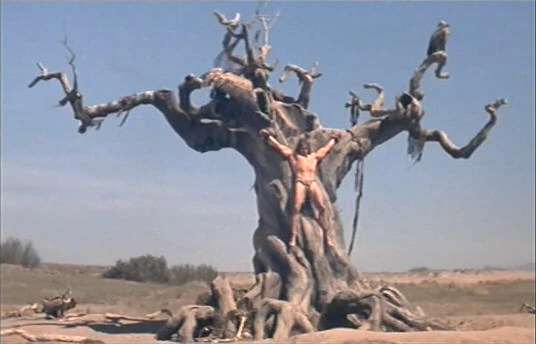
The Riddle of Steel". Conan's parents are slaughtered by a raiding party of Thulsa Doom, and young Conan is abducted into slavery. Somehow as a slave he manages to grow big and strong by pushing a human powered grist mill, so he matures into a gladiator and is doted on by his captors, learns to read and write, and learns advanced fighting skills, finally he's set free, where he becomes a thief, meets two companions, and conceives of a plan to exact revenge on Thulsa Doom. He confronts Thulsa Doom, but is defeated and crucified on the Tree of Woe. He's resurrected by a sorcerer and finally defeats Thulsa Doom and decapitates him.
The Conan character seems to be a product of the historical theorizing of the 19th and 20th centuries. Researchers sought to explain the origins of Western civilization through archaeological and linguistic evidence. (See the
Kurgan Hypothesis as a similar example.) They sought, like Hegel, or for a modern example see Jared Diamond's
Gun Germs and Steel, an underlying mechanism or reason for how western civilization evolved.
So the Conan character is drawn from imagining the remote, pre-christian, even pre-classical past, but also serves as a microcosm of History. Conan, by virtue of acquiring knowledge and an expanding consciousness transforms multiple times until he finally gets backstage with Thulsa Doom.
Doom's two snake headed insignia is a version of the
Caduceus. In the movie, he plays a dark trickster, who keeps the masses hypnotized and in his thrall. However, he also serves as Conan's tutor. He provides an explanation for the riddle of steel, that steel is weaker than the hand that wields it, and the ultimate power is the power of mind. He's responsible for the ultimate transformation of Conan. As the Egyptian God Seth binds Osiris in a form fitting coffin, Thulsa Doom pins Conan to the Tree of Woe. Like
Odin who hangs from a tree for nine days to learn the runes, Conan dies and is resurrected with new wisdom that allows him to infiltrate Thulsa Doom's cult and finally defeat and decapitate him.